Sound familiar?Central
- The call
- You just leased the empty unit next door and want the new tenant to open their own suite without a key to yours, to the loading dock, or to the electrical room down the hall.
Something went missing from the storeroom over a weekend, and when you ask who was in the building, the honest answer is anyone with a key. There is no list, no time stamp, no way to narrow it down.
Credentials take several forms, and most installations end up mixing them: a proximity card or fob held near a reader, a keypad code typed at the door, or a mobile credential read from a phone. Cards and fobs are simple to hand out and just as simple to switch off if lost; a code needs no hardware to issue but has to be changed once shared too widely; a mobile credential ties entry to a device the person already carries. The mix is chosen door by door, based on who uses each one and how often.
Sound familiar?Central
Access Control Installation · Central
Scene 1
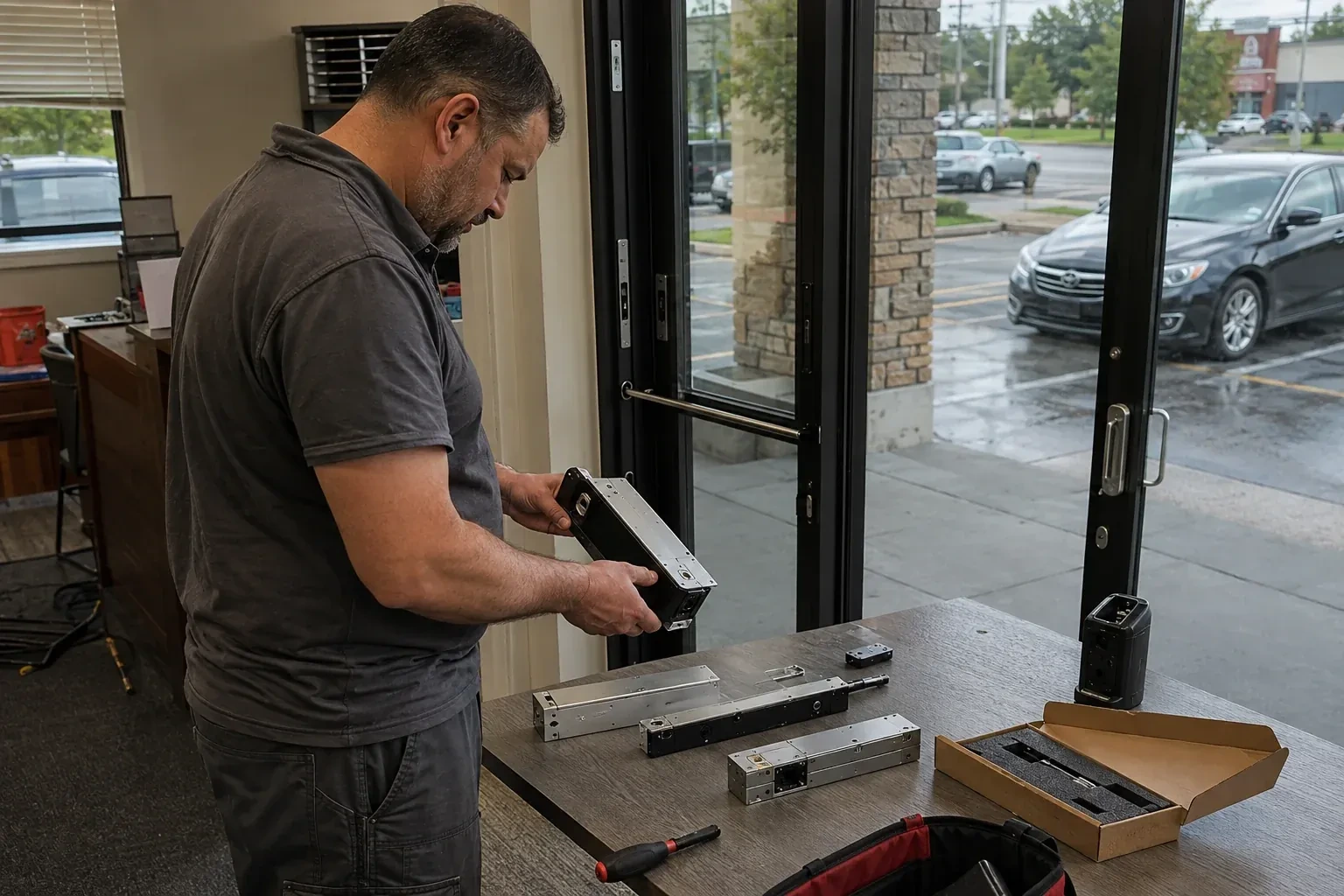
Every opening gets a physical look before it gets any wiring. The locksmith checks what the door and frame are made of, which way the door swings, whether an electric strike will seat cleanly in the existing frame, and whether the door sits on a fire separation, which changes what can be added to it. A hollow metal frame, a wood door, and an aluminum storefront door each take different hardware, and a door that already sits loosely in its frame is noted before an electric strike or a magnetic lock is chosen for it, since alignment decides how reliably the lock releases.
Scene 2
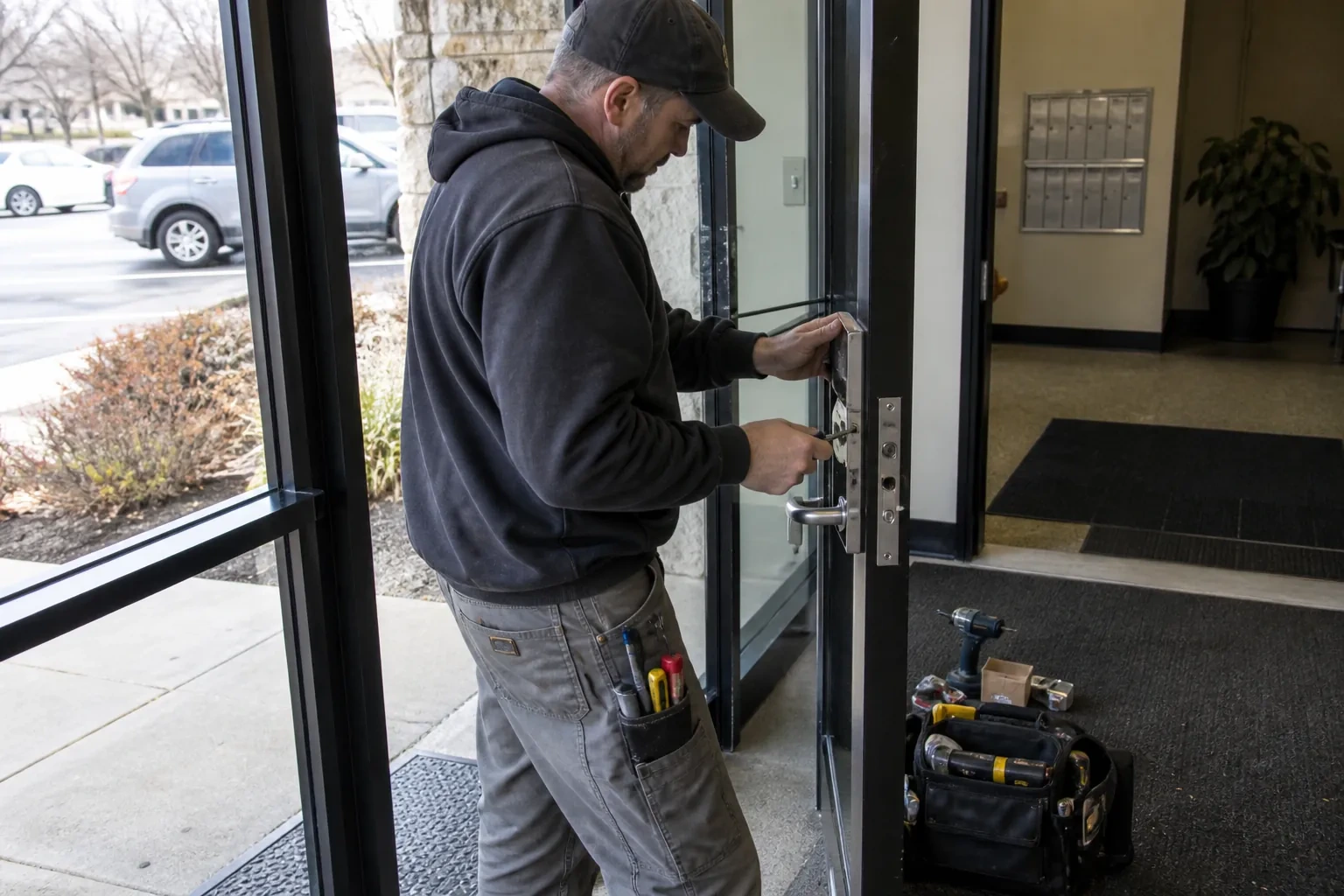
Where the frame allows it, an electric strike replaces the fixed keeper the latch normally strikes against, so the door keeps its existing latch and lockset and simply releases the strike plate when a valid credential is presented. The locksmith mortises the frame to fit the strike body, runs a low-voltage cable within the frame or jamb back to the controller, and sets the strike to hold the door secure until the controller sends a release signal. Because the latch itself never changes, the door still closes and locks normally by hand at any time, credential or no credential.
Scene 3
Every controller keeps a record of which credential was presented at which door and when, and, where a door position switch is fitted, whether the door actually opened; that log is available to the administrator whenever it is needed, not only after something has gone wrong. Pulling a recent day's entries for the stockroom, checking whether the loading dock was opened outside its scheduled window, or confirming a contractor's credential was only used on the days they were on site are ordinary lookups rather than a special request, though the record shows the credential used rather than proof of who held it. Reviewing the log occasionally, rather than only when there is a problem, is a genuinely useful habit.
What shapes the quoteBuchanan Lock Services
FeesSame any hour
A keypad code needs no card to lose, but a code shared among several people is effectively no longer individual, and a forgotten code left active is a common weak point. A card or fob tied to one named person avoids that particular issue, since it is switched off individually rather than reset for everyone at once. Many businesses use a code for general areas and a card wherever entry needs to be traceable to one person.
Outage behaviour depends on how that opening was built: battery backup can be sized to carry the reader, the lock and the controller through a typical outage, so a brief power loss need not lock anyone out or, on a fire-alarm-tied opening, lock anyone in, but that backup and any mechanical key override are specified per opening rather than assumed for every door. Fail-safe hardware unlocks once power has been out longer than the backup lasts; fail-secure hardware stays locked, and what opens it depends on the hardware chosen.
Yes. Access levels can be set to change automatically by time of day or day of the week, so a credential that opens a door during a shift can be denied outside it without anyone having to remember to switch it off manually. This is set up once in the schedule and then runs on its own from that point forward.
HamiltonOntario
Access Control Installation · Hamilton, Buchanan, Chedoke Park, Cootes Paradise, Corktown, Hamilton Beach, Hopkins Court, Hopkins Survey, McDonald Court, North End, University Gardens, Waterdown, West Hamilton, Westdale, Pleasant View Survey
Every square is one home in a hundred.
On-site assessment
Something went missing from the storeroom over a weekend, and when you ask who was in the building, the honest answer is anyone with a key.
(289) 203-1527, open 24/7.
On-site assessment preferred · (289) 203-1527, open 24/7